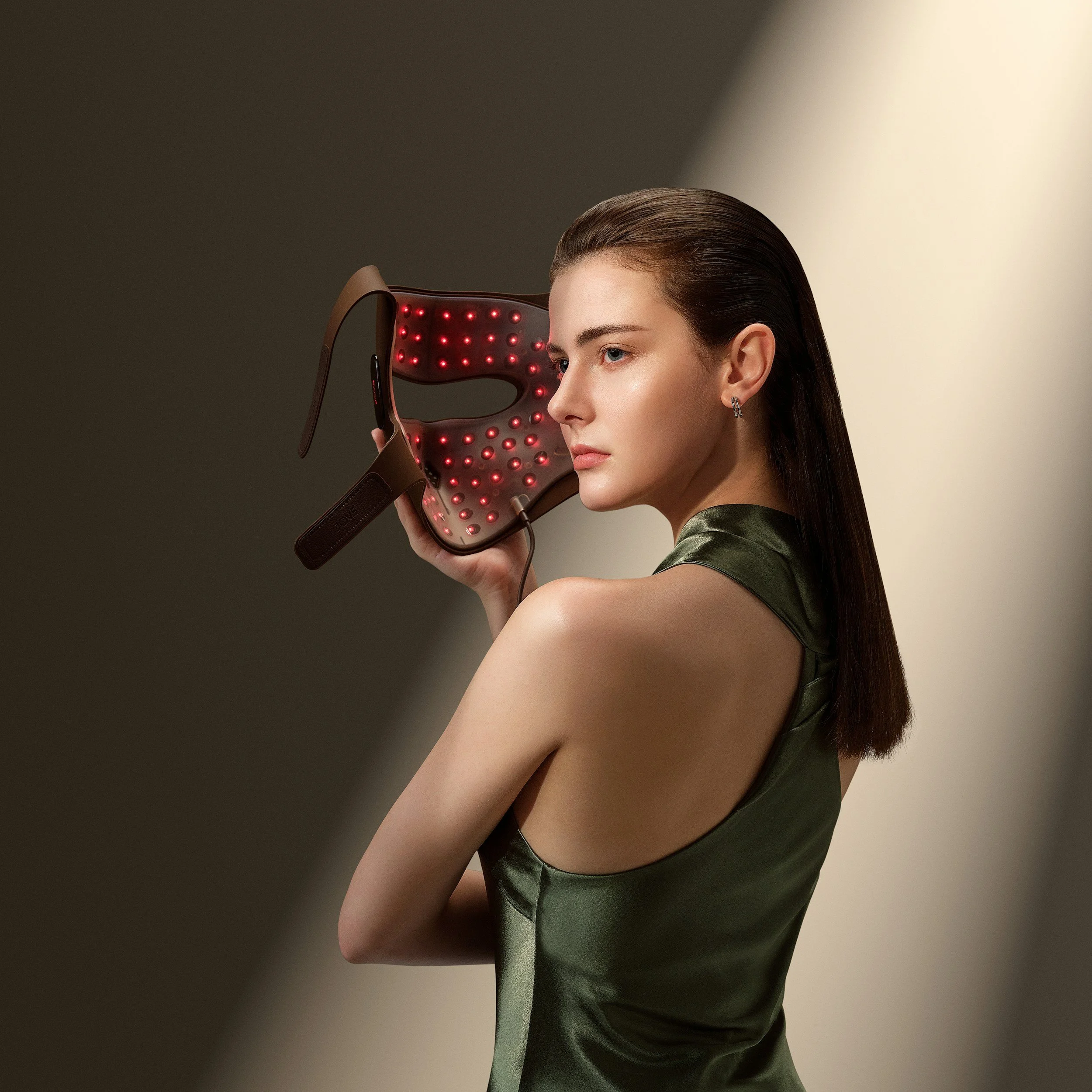
If your Instagram and TikTok feed is anything like mine, you'll probably have noticed that half the women on there spend their evenings bathed in red light. Red, blue, pink… whatever the colour, these futuristic-looking masks have become quite the beauty accessory.
Millie Mackintosh is one celebrity who raves about red light therapy, regularly sharing her skincare and wellness treatments online and she's not the only one. LED masks have become a favourite among beauty influencers, with the promise of stimulating collagen, firming skin, boosting dullness, improving texture and even targeting acne, inflammation, pigmentation and dark spots.
Research commissioned by beauty booking platform Fresha suggests searches for 'LED masks' have increased by 124% over the past year and big brands including Shark, CurrentBody, Omnilux all offer devices, with price tags from around £100 to well over £500.
It's a trend that's showing no signs of slowing down. And, as we hurtle towards Christmas, I suspect quite a few of these glowing gadgets will be making their way onto Santa's list. But before you add one to yours, it's worth asking the obvious question: do LED masks actually work, or are we simply paying a lot of money for some pretty lights?
What exactly is an LED mask?
LED stands for light-emitting diode, and the technology behind these devices is called photobiomodulation. Essentially, specific wavelengths of low-level light are delivered to the skin without heating or damaging it in the way some other light-based treatments can.
Red light and near-infrared light are the two wavelengths most commonly associated with skin rejuvenation. Red light typically sits around 630–670nm, while near-infrared is often around 800–850nm. Different wavelengths interact with the skin at different depths. The theory is that light influences cellular processes involved in energy production, inflammation and tissue repair.
'Red light can influence how skin cells work,’ explains Dr Samila Asad, GP and wellness specialist at The Female Health Doctor Clinic. ‘These include the processes involved in inflammation and collagen production. One proposed explanation is its effect on the mitochondria, the structures inside our cells responsible for producing energy. The light isn't burning or resurfacing the skin, but the type of light, the amount reaching your skin and the treatment time all matter. Simply being a red light doesn't mean it will have the same effect.'
So, do they actually work for wrinkles?
The big promise behind LED masks is that they can stimulate collagen production, improve skin texture and soften fine lines. And there is some encouraging research behind it. A 2025 study involving 60 people aged 30–65 tested a home-use mask combining red and near-infrared light. Those using the active mask saw improvements in crow's feet compared with a second group using a dummy version of the device. Differences became apparent after eight weeks.
Another 2025 study looked at 95 women aged 45–60 who used a red LED mask two or three times a week for four weeks. Although some improvements were seen, the main assessment of wrinkles found no significant difference between those using the mask and those using a dummy device. As we move through midlife, changes in collagen, elastin and facial structure can all affect how our skin looks.
Why not find out more about why your face changes in midlife and what you can actually do about it here.
'With a suitable device and regular use, you may see some improvement in fine lines and skin texture,’ says Dr Asad. ‘I would describe it as a gradual improvement in how the skin looks. I wouldn't expect a mask to lift sagging skin, replace lost volume or get rid of deep wrinkles. I'm always cautious about the phrase “boosts collagen,” because it can sound as though you're guaranteed to see a dramatic difference, but that isn't what the evidence tells us.’
And, when a brand describes a device as clinically proven, Dr Asad suggests asking: ‘What exactly has been proven? A study funded by the manufacturer isn’t automatically unreliable, but it needs to be transparent. And a laboratory finding about collagen isn’t the same as showing that people developed visibly fewer wrinkles.’
What about acne?
Blue light has also been investigated as a treatment for acne, with some encouraging findings. A 2025 review looked at six studies involving 216 people with mild-to-moderate acne. It found that at-home red and blue LED devices helped reduce both inflamed spots and non-inflamed blemishes compared with control treatments. Improvements were generally seen over four to 12 weeks. However, the researchers also highlighted differences between the devices, wavelengths and treatment routines used. The results are promising, but they don't mean every blue-light mask will clear your skin.
Not all LED masks are created equal
These devices differ with colours, wavelengths, numbers of lights featured, treatment times and prices. Some are flexible silicone, others are rigid plastic, and brands are keen to tell us why their particular design is superior. But does any of this actually matter?
‘Yes,’ states Dr Asad, 'The wavelength affects how the light interacts with the skin, while the power reaching the skin and the session length help determine the dose.' There are three things worth understanding: wavelength (type of light being used), irradiance (how much light energy reaches the skin) and dose (the energy delivered over the treatment time).
A mask boasting hundreds of LEDs isn't necessarily more effective than one with fewer lights. Flexible silicone designs may sit more closely against the skin than rigid plastic alternatives, but that doesn't automatically translate into better results. 'I'd be more interested in the research behind the device than the price tag,’ says Dr Asad. ‘Spending more doesn't automatically mean better results.’ Instead, she says to check: ‘Has that particular mask been tested? Does the company clearly explain the wavelengths, treatment dose and safety instructions?'
You'll often see masks offering several light settings, with each colour promising to tackle a different skin concern. But the evidence for this also varies. ‘I would qualify some of those claims,’ she says. ‘The evidence isn’t equally strong for every colour. Red light, around 630–660 nm, has been studied for fine lines and skin rejuvenation. It may support collagen-related processes, but that is different from guaranteeing visibly firmer skin. Blue light has evidence for acne, particularly around 415 nm. It acts on light-sensitive compounds produced by the bacteria involved in acne. But acne is more complicated than bacteria alone, so a mask won’t address every factor contributing to breakouts. With amber or yellow light, I would be cautious about presenting it as a proven home treatment for redness or rosacea. I’d be similarly cautious about green light for pigmentation. I wouldn’t advise someone to buy a mask specifically to treat melasma or dark patches on the strength of that claim. Near-infrared light generally reaches further into the skin than blue or green light and is often studied alongside red light. But deeper doesn’t automatically mean better. I wouldn’t be persuaded by the number of colour settings alone. I’d want evidence for the concern I’m trying to treat.’
How often do you need to use one?
Most devices need regular use over several weeks and it’s always best to follow the instructions for the mask you’re using. But in terms of results, studies suggest improvements can take several weeks, so don't expect a dramatic difference before Christmas. ‘In one home-mask study, differences in wrinkle scores became apparent from around eight weeks,’ she adds.
Are LED masks safe?
LED masks are generally marketed as non-invasive treatments, but that doesn't mean they're suitable for everyone. People with conditions that make them sensitive to light, such as lupus, or those taking medication that can cause photosensitivity should check with a clinician before using one. Pigmentation is another consideration. Dr Asad advises people with melasma, darker skin or a tendency to develop pigmentation to seek advice first. Eye protection is important too. Follow the manufacturer's instructions and use any protection specified. Don't assume closing your eyes is enough.
The Wellness Editor verdict: worth it or waste of money?
The science is promising. There is evidence that certain red and near-infrared devices can improve some signs of skin ageing, while blue light may help with mild-to-moderate acne. But research into individual at-home devices is still developing. Which? has tested 10 LED masks priced between £140 and £579, assessing their performance over six weeks. Its testing includes facial scans and dermatologist assessment, rather than relying solely on manufacturers' claims. However, the initial results involved just two testers per mask, so be wary this is definitive proof that one device is better than another.
If you're considering other ways to improve your skin, read our guide to the midlife aesthetic treatments worth considering here.
So, would Dr Asad buy a mask? 'I'd get the basics right first: daily broad-spectrum sun protection, a gentle cleanser, a suitable moisturiser and, where appropriate, a retinoid introduced carefully. Once those things are in place, a well-studied LED mask could be an optional extra. But you don't need to spend £400 to look after your skin well.'
LED masks aren't necessarily a gimmick, but they're not a skincare miracle either. Just make sure you have realistic expectations - Santa might not deliver a new face along with it.